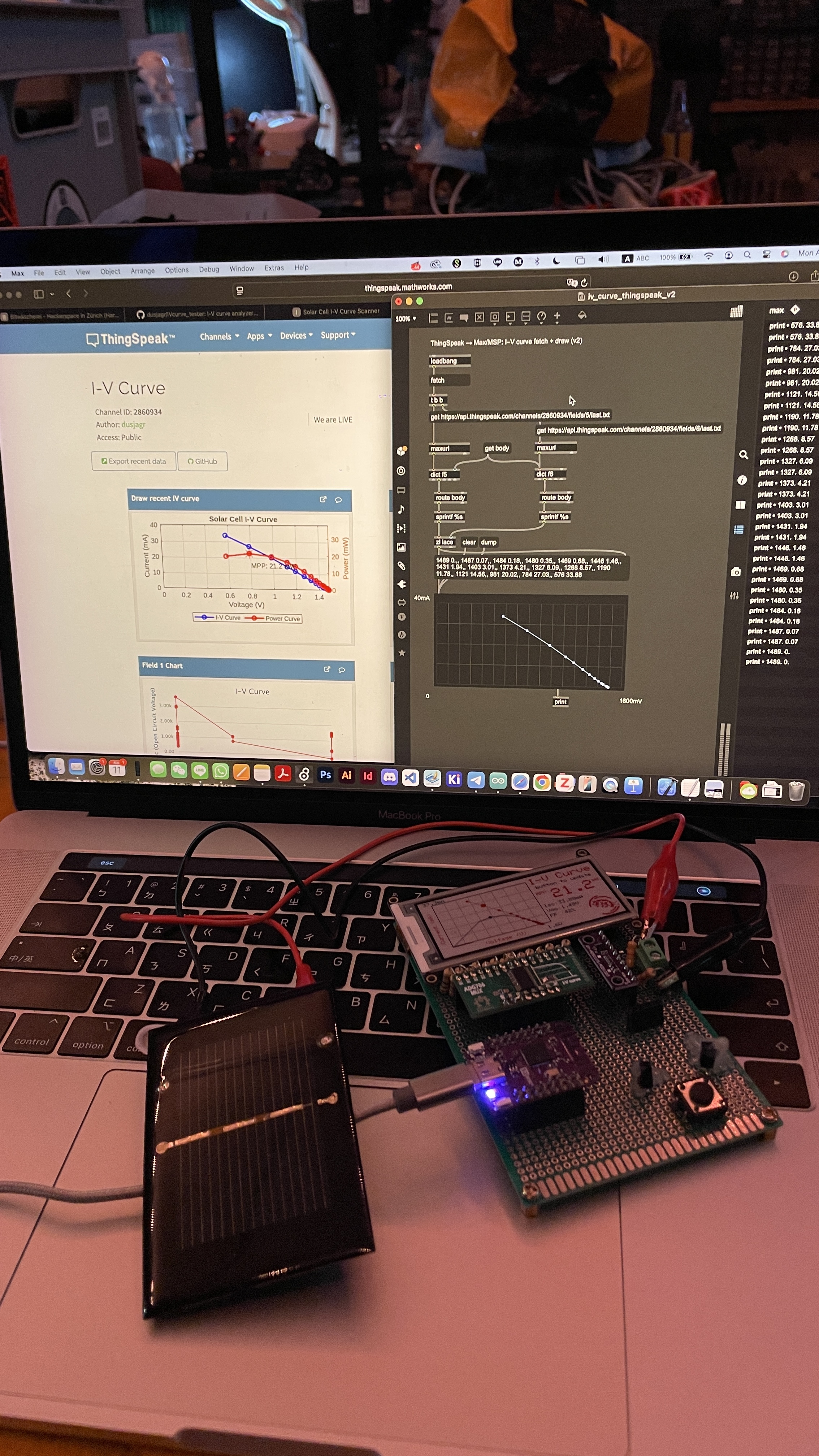
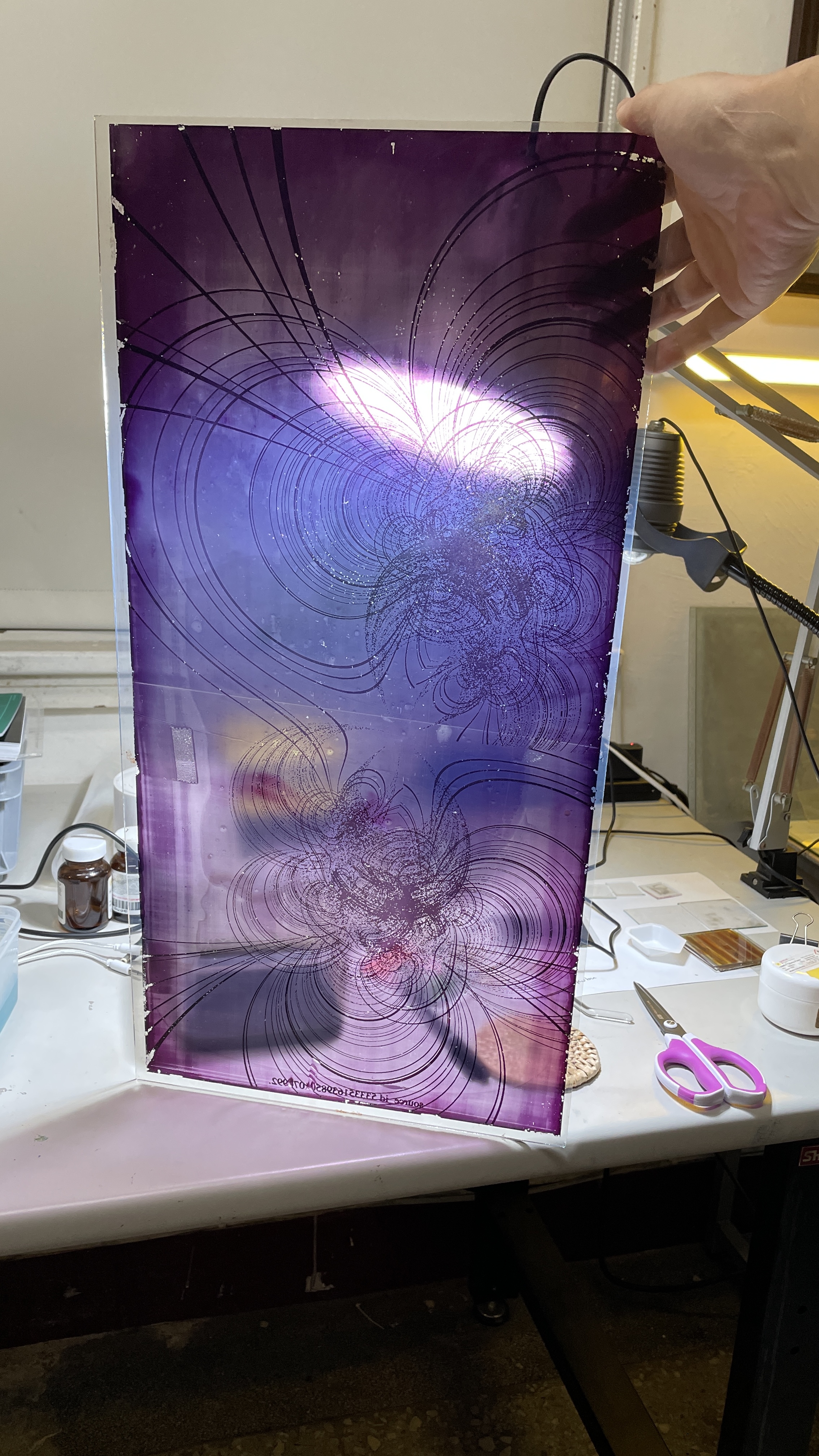
《Solar Oracle Walkman》從一片會發電、也會留下自身差異的玻璃開始。作品利用手工染料敏化太陽能電池(DSSC)中難以完全控制與重現的二氧化鈦多孔層及界面差異,測試其作為物理不可複製函數(PUF)與能源來源身分的可能。裝置在既定的跨光源條件下讀取每片元件的 I–V 曲線,再將電性回應轉譯為生成音樂,使材料差異進入公共感知:觀眾聽見的不是固定的身分碼,而是一種在材料、光線、時間與量測之間持續形成、雖會變動卻保有可辨識連續性的關係。作品的核心提問是,同一片材料能否在產生電力的同時,也參與證明「這筆能源來自誰」;材料指紋並不取代電表、數位簽章或憑證核發制度,而是與電量、時間及裝置紀錄共同構成可追溯的能源來源證據。
透過可攜式 Walkman / 太陽能身份驗證裝置,這項技術問題被擴展為一個關於代理、分配與自我邊界的制度想像。作品以「幽靈 GDP」描述帳面產出與實際生活經濟逐漸脫節的狀態,並以「人類智力位移螺旋」推演代理能力提高、白領職位與消費能力下降,而企業又為維持利潤持續投資自動化代理的循環。當受雇的人類不再是生產與分配之間可靠的連接點,能源、算力與行動能力將依據什麼原則配置?能源與算力有物理限制,制度卻會在其上疊加身分登錄、重複核驗、中心化授權與所有權圍籬等行政瓶頸。一筆經驗證的能源事件本身沒有預定的經濟形式;它可以被轉譯為鞏固既有權威的私有資產,也可以成為不必完全資產化、用以支持個體行動的使用權、參與權或有限代理權。
「捉摸不定的作者」(elusive author)是用來形容分布式生產中模糊且分散的作者身份。Linux、數位取樣、remix、遊戲模組與同人文化都顯示,創作並非由一個位於作品之前的單一作者憑空完成,而是在程式碼、版本紀錄、維護、社群協調、重組與回應中逐步生成。當這種多重來源的作者性進入法律,便形成近乎自我抵銷的困境:它若把自己壓縮成唯一作者,就背叛了自身的生成方式;若拒絕單一中心,又可能難以被現有制度辨認。作品進一步想像法律如何離開單一作者權威,轉向能容納多重真實、重疊規則與持續修訂的結構。
在《Solar Oracle Walkman》的制度沙盒中,作品暫時假定 DSSC 的材料身分與光伏輸出已達足以被制度採用的可信度。材料指紋、I–V 量測、電表紀錄、數位簽章、代理行動、規則版本與參與者留下的痕跡,因而可以共同構成分布式見證,而不再只由單一管理者宣告「這是誰的事件」。分布式作者性與分散式綠色證明並不是同一件事,卻共同鬆動了「聖潔的起源」與「主權式的中心」:自我不再是封閉並擁有一切的實體,而是在技術、物質、環境與社會關係交會時暫時形成的一致性效果。這並非讓 DSSC 取代人成為新的浪漫作者,而是讓能源來源、裝置維護、模型、規則、生成過程、署名與責任得以分開辨認,再由重疊的規則決定它們如何關聯。作品最終追問:當材料身分被用來授權能源代理時,「自我」可以委派什麼,又有哪些判斷與責任不能被委派?分散認知又將如何進入未來的公共能源平台,使感官哲學、憑證設計與技術工程必須被共同思考?
Solar Oracle Walkman begins with a piece of glass that generates electricity while also leaving a trace of its own difference. The work investigates whether variations in the porous titanium dioxide layer and interfaces of handmade dye-sensitized solar cells (DSSCs)—variations that are difficult to fully control or reproduce—can function as a physical unclonable function (PUF) and form the basis of an energy-source identity. Under a controlled cross-light-source protocol, the device reads the I–V curve of each cell and translates its electrical response into generative music, bringing material difference into public perception. What the audience hears is not a fixed identity code, but a relationship continually formed through material, light, time, and measurement: one that changes while retaining a recognizable continuity. The work’s central question is whether the same material can generate electricity while also helping to prove where that energy came from. The material fingerprint does not replace the meter, the digital signature, or the certificate issuer; rather, it joins energy data, time records, and device logs to form a traceable chain of evidence for energy origin.
Through a portable Walkman and solar identity-verification device, this technical question expands into an institutional speculation about agency, distribution, and the boundaries of the self. The work uses “ghost GDP” to describe a condition in which measured output increasingly diverges from everyday economic life, and the “human-intelligence displacement spiral” to imagine a cycle in which automated agency grows, white-collar employment and consumption decline, and companies invest even more heavily in automation to preserve profits. If employed human beings no longer provide a reliable link between production and distribution, according to what principles should energy, computational capacity, and the ability to act be allocated? Energy and computation have physical limits, yet institutions add further administrative bottlenecks through identity registration, repeated verification, centralized authorization, and legal barriers constructed around ownership. A verified energy event has no predetermined economic form: it can be translated into private property that reinforces existing authority, or into non-assetized rights of use, participation, or limited agency that support individual action.
The “elusive author” describes a form of authorship in distributed production that cannot be fully contained by a simple list of names. Linux, digital sampling, remix, game modding, and fan cultures all show that creation does not emerge from a single author positioned before the work. It develops through code, version histories, maintenance, community coordination, rearrangement, and response. When this multi-sourced authorship enters the law, it encounters an almost self-cancelling problem: if it compresses itself into a single author in order to become legally recognizable, it betrays the way it was produced; if it refuses a single center, existing institutions may struggle to recognize it. The work therefore imagines how law might move beyond the authority of the singular author toward structures capable of holding multiple realities, overlapping rules, and continual revision.
Within the institutional sandbox of Solar Oracle Walkman, the material identity and photovoltaic output of each DSSC are provisionally assumed to have reached a level of trust sufficient for institutional use. Material fingerprints, I–V measurements, meter records, digital signatures, agent actions, rule versions, and the traces left by participants can then form a system of distributed witnessing, rather than leaving a single administrator to declare, “This event belongs to this source.” Distributed authorship and distributed green proof are not the same thing, but both unsettle the ideas of a “sacred origin” and a “sovereign center.” The self is no longer understood as a closed entity that owns everything it produces, but as a temporary coherence formed where technical, material, environmental, and social relations meet. This does not turn the DSSC into a new romantic author. Instead, it allows energy sources, device maintenance, models, rules, generative processes, attribution, and responsibility to be identified separately, then related through overlapping systems of rules. The work ultimately asks: when material identity is used to authorize an energy agent, what can the self delegate, and which judgments and responsibilities cannot be delegated? How might distributed cognition enter future public energy platforms—and require sensory philosophy, certificate design, and technical engineering to be considered together?